Should You Get a Biosensor Certification? (Honest Comparison with NASM, ACE, ISSA)
The Question Every Trainer Asks
"I already have my NASM/ACE/ISSA. Do I really need another cert?"
Short answer: Not instead of. In addition to.
Better answer: Depends on where you want your career to go.
Let's take a closer look.
What Your Current Cert Taught You
Whether you have NASM, ACE, or ISSA, you learned:
✅ Exercise science fundamentals
✅ How to design programs
✅ Anatomy and biomechanics
✅ Client assessment
✅ Basic nutrition guidelines
✅ Professional standards
This qualifies you to train people safely and effectively.
Question: Does it set you apart from the 740,000 other certified trainers?
What Biosensor Certification Teaches You
A biosensor certification, such as the BioFit Specialist, focuses on one specialized skill.
It teaches you how to use real-time metabolic data to improve training and nutrition.
Specifically:
How continuous glucose monitors actually work
How to interpret glucose patterns (not just blood sugar)
What adjustments to make based on data
When someone needs a medical referral
How to package and price premium services
This is NOT covered in traditional certs.
The Analogy That Makes It Clear
Think of it like medical training:
Traditional cert (NASM/ACE/ISSA) = Medical school
→ Broad foundation, necessary for everything
Biosensor cert (BioFit) = Cardiology fellowship
→ Deep expertise in one area, premium value
You need BOTH.
General practice medicine pays $200K/year.
Specialized cardiology pays $400K/year.
Same dynamic in fitness.
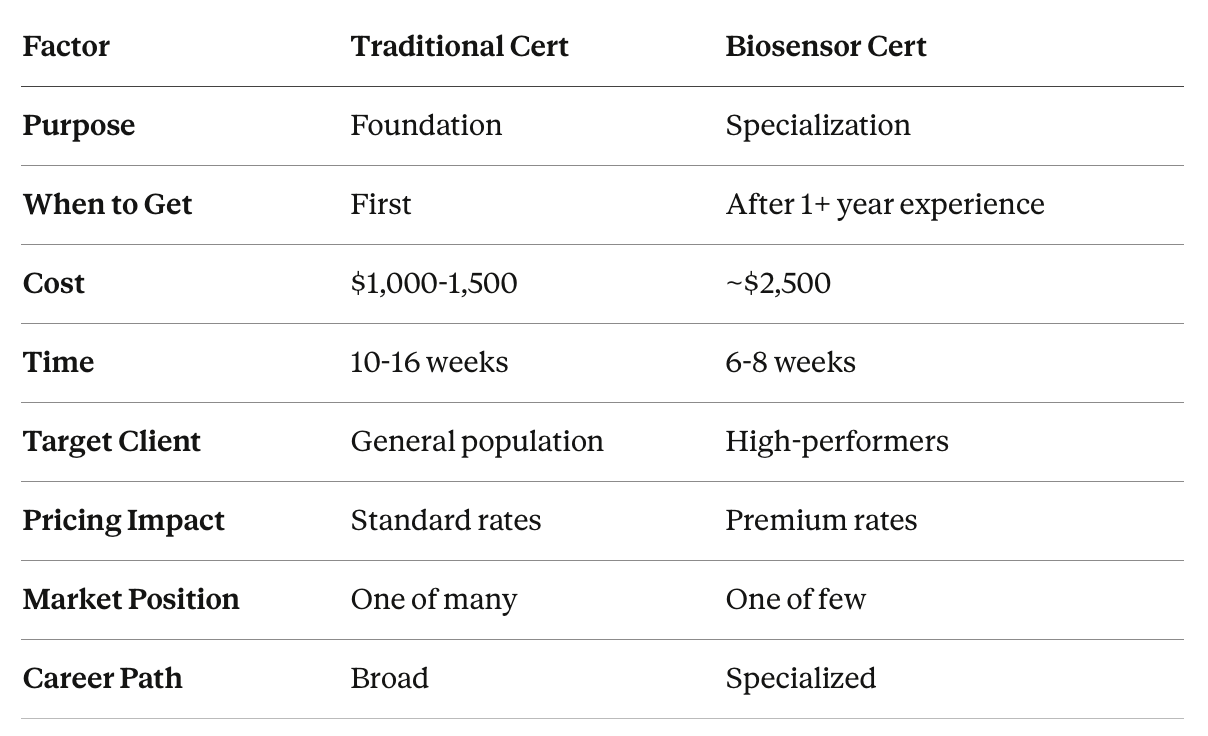
Side-by-Side Comparison
WHAT THEY COVER:
Exercise Programming
✓ Extensive△ Assumed you know this
Anatomy & Biomechanics
✓ Detailed△ Basics only
General Nutrition
△ Overview△ Not the focus
Glucose Physiology
△ One chapter✓ Entire curriculum
CGM Technology
✗ Not covered✓ Comprehensive
Metabolic Data
✗ Not covered✓ Core skill
Pattern Recognition
✗ Not covered✓ Extensive training
Scope of Practice
✓ General✓ Biosensor-specific
Who They Prepare You For:
Traditional Cert:
General population
Weight loss clients
Basic fitness goals
Group classes
Gym floor training
Biosensor Cert:
High-performers
Athletes
Executives
People with metabolic concerns
Clients who've plateaued
Data-driven individuals
These certifications attract different types of clients and lead to different pricing.
Business Impact:
Traditional Cert:
Entry to the industry
Gym employment qualification
Standard hourly rates ($15-75/hour)
High client volume is needed
Biosensor Cert:
Market differentiation
Premium positioning
Higher rates ($150-300/session)
Lower volume, higher revenue
Cost Comparison (Real Numbers)
NASM CPT:
Cost: $849-1,499 (depending on package)
Time: 10-12 weeks
Recertification: $99/2 years + 20 CEU hours
ROI: Necessary for entry to the field
BioFit Specialist:
Cost: ~$2,500
Prerequisites: Must have an existing fitness cert
Time: 6-8 weeks (part-time)
ROI: 2-3 premium clients = break even
The ROI Math:
Investment:
Traditional cert: $1,000-1,500
Biosensor cert: $2,500
Total: $3,500-4,000
Scenario A: Traditional Cert Only
Rate: $65/session
Clients/week: 25
Weekly income: $1,625
Annual: $84,500
Scenario B: Traditional + Biosensor
Rate: $150/session
Clients/week: 18 (fewer needed)
Weekly income: $2,700
Annual: $140,400
Difference: $55,900/year
Biosensor cert pays for itself in about 1 month.
The Blunt Truth About Traditional Certs
WHAT NO ONE TELLS YOU:
NASM, ACE, and ISSA are great certifications.
But they're also extremely common.
The numbers:
740,000 certified trainers in the US
4.4% annual growth
Average income: $40,000-60,000/year
Most compete primarily on price
Translation: The traditional cert market is saturated.
Your options:
Compete on price (race to the bottom)
Specialize (premium positioning)
Biosensor certification is a specialization.
Who Should (And Shouldn't) Get Biosensor Certified
✅ YOU SHOULD GET IT IF:
You're already established:
Have 1+ years of experience
Current client base
Want to charge more
Ready to level up
You want premium clients:
Athletes and high-performers
Executives and professionals
People who value data/results
Clients willing to invest
You're entrepreneurial:
Want to differentiate
Building a brand
Think long-term
Willing to invest in yourself
You're tech-comfortable:
Use apps daily
Interested in wearable tech
Like data and patterns
❌ YOU SHOULD WAIT IF:
You're brand new:
No existing cert → Get NASM/ACE/ISSA first
Less than 1 year of experience → Build foundation
No private clients yet → Establish base first
You're struggling with basics:
Can't fill your schedule → Fix business fundamentals
Charging <$50/session → Work on positioning
High client turnover → Improve coaching skills
You hate technology:
Don't use apps → This isn't for you
Overwhelmed by data → You'll struggle
Prefer old-school methods → Stick with that
You only want the cheapest option:
Price-shopping certs → You'll get what you pay for
Not willing to invest → Results match investment
What The Market Actually Wants
THE SHIFT HAPPENING RIGHT NOW:
2020: Generic training thrived
2024: Apps and AI disrupted generic training
2026: Specialization is the only moat
Think about it:
$10/month fitness apps with AI coaching
YouTube has unlimited free workouts
ChatGPT can write workout programs
What can't be replaced by technology?
Expert interpretation of complex data + personalized coaching.
This is what biosensor coaching offers.
Stories from Trainers
BEFORE AND AFTER:
Jessica - Before:
NASM certified
$60/session
28 clients/week
Exhausted, burned out
Income: $87,360/year
Jessica - After BioFit:
Same NASM cert + BioFit
$175/session
16 clients/week
Sustainable, energized
Income: $145,600/year
Same hours. $58,240 more.
Mike - Before:
ACE certified
Gym floor trainer
$22/hour
No path to growth
Mike - After BioFit:
Left gym employment
Launched "Metabolic Performance Coaching"
8 clients at $2,800 each (12-week programs)
First quarter: $22,400
On track for $90K+ first year
Sarah - Before:
ISSA certified
Online coach
Competing with thousands of others
Hard to differentiate
Sarah - After BioFit:
"The only online coach in my niche using CGMs."
Raised prices 60%
Waitlist of 12 people
Featured in local news as "tech-forward coach."
Specialization created an opportunity.
The Real Question
It's not "Should I get certified?"
It's "Where do I want to be in 3 years?"
Path A: No Additional Specialization
Likely outcome:
Competing with apps and AI
Pressure to lower prices
High client volume required
Income plateaus
Moderate satisfaction
Path B: Biosensor Specialization
Likely outcome:
Unique market position
Premium pricing justified
Lower client volume, higher income
Continuous learning and growth
High satisfaction
Both paths are valid. Which appeals to you?
How to Decide
ASK YOURSELF:
1. Career Goals:
Do I want to be known as an expert?
Am I building a personal brand?
Do I want to work with high-performers?
2. Financial Goals:
Am I happy with my current income?
Do I want to work fewer hours for the same/more money?
Am I willing to invest to increase earning potential?
3. Client Preferences:
Do I enjoy data-driven coaching?
Do I want engaged, motivated clients?
Am I comfortable with technology?
4. Market Position:
How saturated is my local market?
How do I currently differentiate?
What unique value do I offer?
If you answered "yes" to most questions → Biosensor cert makes sense.
If you answered "no" to most → Focus on maximizing traditional cert first.
What Actually Happens When You Get Both
THE POWER OF FOUNDATION + SPECIALIZATION:
Your traditional cert (NASM/ACE/ISSA):
Gets you in the door
Proves basic competency
Required for insurance
Baseline credibility
Your biosensor cert (BioFit):
Differentiates you
Commands premium pricing
Attracts ideal clients
Creates a competitive moat
Having both positions you as"A qualified professional trainer WITH specialized expertise in metabolic optimization."
That's a powerful combination.
The Investment Decision
HERE’S HOW TO THINK ABOUT IT:
Traditional cert ($1,000-1,500):
Necessity: Required to enter the field
ROI: Gets you your first clients
Ongoing value: Baseline qualification
Biosensor cert ($2,500):
Necessity: Optional but strategic
ROI: 2-3 premium clients = break even
Ongoing value: Differentiator for entire career
Is $2,500 a lot?
Compare to:
A used car: $15,000
One year of student loan payments: $5,000+
Most business investments: $10,000+
For a skill that can increase income by $30-50K/year?
That's actually cheap.
Next Steps
IF YOU’RE STILL EXPLORING:
1. Free Resources: → Download: CGM Revenue Blueprint
2. Attend Free Masterclass: → Watch BioFit Masterclass
If You're Ready:
Apply for BioFit Certification: → Start application
Final Thoughts
You don’t need biosensor certification to be a good trainer.
You need it to be a highly paid specialist in an increasingly competitive market.
Your traditional cert taught you to train people.
Biosensor cert teaches you to optimize metabolism with data.
One is broad. One is deep.
One is common. One is rare.
One gets you in the game. One helps you win.
The question isn't whether biosensor coaching is legitimate (it is).
The question is whether it fits YOUR career goals.
If you want to:
Work with premium clients
Charge premium rates
Differentiate in a crowded market
Build a specialized brand
Then yes, get biosensor certified.
If you’re happy with your current path, stay on it.
Both are valid choices.
Explore BioFit Certification →
Questions? Contact Us